
Tungabhadra Dam - Salar Jung's Nazrana to the Deccan

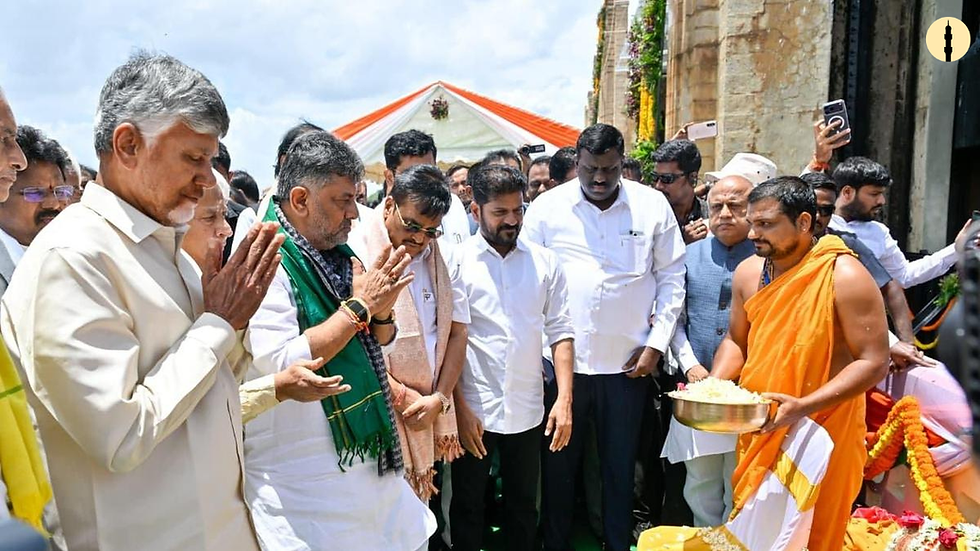
On Thursday, June 25, 2026, the crest of the Tungabhadra Dam wore a crown of quiet history. Andhra Pradesh Chief Minister N. Chandrababu Naidu, Karnataka Chief Minister D.K. Shivakumar, Telangana Chief Minister A. Revanth Reddy, and Union Jal Shakti Minister C.R. Patil stood as one, heads bowed in prayer, as the new spillway gates were consecrated to the river. For millions of tillers across three states, this was more than steel and concrete. It was a rebirth of monsoon hope, a promise that parched furrows would drink again.
But family's accounts suggest otherwise. Beneath the roar lies a liquid archive of Deccan sovereignty, and this very month we remember the birth of Nawab Salar Jung III — the last, wistful custodian of an empire within an empire. The bed of this mighty reservoir was once the sacred soil of his personal jagir, and to understand the waters our leaders blessed, we must walk back through the mist of treaties, telegrams, princely pride to the eventual democratic setup.

The foundation of that princely domain was laid in the restless year of 1853. By the Treaty of May 21, 1853, the vast territory of Koppal in the Raichur Doab was assigned to Nawab Seraj-ul-Mulk, the ancestor of Hyderabad’s Reformer and Prime Minister Sir Salar Jung the Great, in exchange for his own jagir of Murtizapur in Berar. The formal reassignment came to pass in 1271 Fasli, corresponding to 1859–1860, when the Koppal Jagir was meticulously measured by the state’s revenue officials. They balanced the cotton-rich lands of northern Berar, valued at Halli Sicca 3,85,698-1-9, against Koppal’s revenue baseline of Halli Sicca 3,97,371-3-11. This was no mere administrative tract. Confirmed as a fully sovereign personal fiefdom of the Salar Jung family, it spread across 158 towns and villages, sheltering nearly 60,000 souls. Within its borders the family held full civil, judicial, and revenue sway, so absolute that even the Nizam’s Sarkar or the British could not touch its earth without formal diplomacy with the Salar Jung estate.

That sovereignty spoke first in the language of railways. On May 13, 1885, Nawab Munir-ul-Mulk, officiating as Prime Minister while his half brother Salar Jung II was at Ootacamund, wrote to British Resident John Graham Cordery. The Great Indian Peninsular Railway wanted land in the Raichur Doab of Koppal Jagir. Munir-ul-Mulk offered two unyielding choices: a permanent annual quit-rent of Halli Sicca 1,300, or a one-time lump sum of Halli Sicca 35,000 — the same terms enforced for the Nizam’s Sarf-e-Khas lands. The precedent was set: infrastructure did not erase princely rights. The Salar Jung estate kept its jurisdictional dignity, and that dignity would soon be tested by a river.

The Tungabhadra’s story began with a British letter and a Hyderabadi silence. On August 16, 1902, Colonel Smart, Chief Engineer of Madras Irrigation, sent Letter No. 968-I, seeking surveys inside the Nizam’s dominions for a joint storage reservoir. The silence that followed speaks volumes. On July 7, 1906, G. F. Handcock, Superintending Engineer of the III Circle, Bellary, wrote from Section III, Letter No. 2951, to Hyderabad’s Chief Engineer for Irrigation. He cited G.O. No. 688 I, dated June 25, 1906, and reminded them of Colonel Baddeley’s unanswered Letter No. 324 of January 30, 1903, offering to discuss a permanent anicut. Nothing had moved. Handcock invited Hyderabad to the site, and a flurry of notes began between the Maharaja Peshkar, the Prime Minister of Hyderabad.
Here the heart of Hyderabad spoke. The Nizam was more than a ruler then. He was guardian to a fourteen-year-old boy, Nawab Salar Jung III, Mir Yousuf Ali Khan, who had been his ward since infancy. And the Nizam would not sell the child’s birthright for “a few lakhs of rupees.” The surveys themselves deepened the wound. British engineers spoke of 13 villages under water. Hyderabad’s Public Works Department found the truth: 54 villages, 57.5 square miles, some 36,800 acres — all of it the Salar Jung family’s personal, sovereign jagir.

Madras came with ledgers and maps. O. A. Smith, Joint Secretary to the Government of Madras, PWD, Irrigation Branch, wrote to the Resident. His surveys showed 61.5 square miles of Hyderabad territory submerged, with 22,195 acres of cultivable land across 23 villages: Veerapagudiam, Kothapalli, Nurnapoor, Veerlapolayam, Thimmapoor, Weetchepooliam, Habeddapah, Moonesoonakam, Demalapally, Malkacherla, Booknapally, Chitteal, Domerapad, Chintalapollum, Vandyconda, Gangarapolly, Godemudaka, Rajahwarum, Popplapolliem, Nadigudda, Saragudipa, Eagewarem, and Yellasuram. Wazirabad, outside the water spread, would still be swept away by the surplus. Madras offered compensation: 25 years’ purchase for lost revenue, market value plus fifteen percent extra for compulsory acquisition to the ryots. And it swore it wanted only “ordinary proprietorship,” not political sovereignty over the reservoir bed.
But in Hyderabad, land was not a commodity. The Nizam’s Minister sent a six-point protest to the Resident in January. The message was loftier than any engineering chart. His Highness had no objection to a project that would benefit Madras Presidency, but he could not consent to sell 54 square miles equivalent to 37,000 Acres of the Salar Jung family’s jagir, with sovereign rights, for cash. It had always been the tradition of His Highness’s House not to part with lands for money. If Madras wanted water, let it give land of corresponding value, with full sovereign rights in exchange, so the Salar Jung jagir would remain intact as a jagir. The Resident, sensing the weight of law and honour, forwarded the protest to Madras with Enclosure N, asking whether political sovereignty was truly needed. Technical control, he suggested, would suffice.
For three decades the river waited. The dispute between Madras, Mysore, and Hyderabad held the famine-threatened banks hostage. Hyderabad held that the December 1936 agreement between Madras and Mysore had sacrificed its riparian rights, and it claimed a 50 percent share of the flow. The deadlock broke in November 1938. The Times of India, November 5, 1938, carried the Secunderabad correspondent’s hope of an early solution. Hyderabad sent its finest: Revenue Member R. M. Crofton, P.W.D. Member Raja Shamraj Rajwant Bahadur, Finance Member Nawab Fakhr Yar Jung Bahadur, Consulting Engineer Nawab Ali Nawaz Jung Bahadur, and Chief Engineer for Irrigation Nawab Ahsan Yar Jung Bahadur. Madras was led by C. Rajagopalachari, T. Prakasam, and Yakub Hasan.
On January 11, 1939, Letter No. 321/P confirmed it. The Chief Engineer and Secretary to Government, PWD, wrote to the Political Secretary, Hyderabad, that the Nizam had approved the minutes of the Fort St. George conference of November 6 and 7, 1938. The clauses were precise, yet princely in spirit. The Madras telegram of November 4 was treated as not sent. The object was a joint scheme for partial exploitation at Malappuram, with absolute rights left for the future. Madras would draw 50 T.M.C.Ft. and Hyderabad 65 T.M.C.Ft. Of Hyderabad’s share, only 50 T.M.C.Ft. was its own; 15 T.M.C.Ft. was joint water, used by Hyderabad to make power and then released 50 miles downstream for Madras, with Hyderabad bearing the transit costs minus evaporation. The Rs. 6,86,00,000 cost of the joint reservoir was to be shared equally. Revenue and irrigation policies would be coordinated. And on November 7, 1938, the minutes were signed by Yakub Hasan, Shamraj Rajwant, T. Prakasam, Fakhr Yar Jung, C. Rajagopalachari, R. M. Crofton, Ali Nawaz Jung, and Ahsan Yar Jung.
By June 1944, the dam was rising. Hyderabad’s Sri C. C. Dalal and Madras’s Sri M. S. Thirumale Iyengar built it together at Malappuram. Yet the old order was already fading. Telegram No. 401-P, dated February 26, 1945, from Government of India, New Delhi, laid down the inauguration order for Bellary district. To balance imperial rank with Hyderabad’s sacrifice, the Prince of Berar, representing the Nizam, was placed first — ahead of the British Resident. The Resident came second, the Nawab of Chhatari third, Advisers to the Governor fourth and fifth, the Ruler of Sandur sixth. And at the very end, seventh and eighth, stood the Member of PWD and Nawab Salar Jung III. It was during this grand dawn of the project's physical realization, at the foundation ceremony on February 28, 1945, that Nawab Zain Yar Jung, serving as the Member of PWD and Commerce and Industries in the Nizam's Cabinet, stood before the assembly. In an inaugural address carrying the full majesty of the Asaf Jahi dynasty, he read out the Nizam's final solemn consent, formally ratifying and binding all Terms of Reference for the historic enterprise. The aging Nawab Salar Jung III, whose ancestral heartland was vanishing underwater, watched the moment unfold in silence and grace.

After Independence, the jagirs fell, but the river remembered. The 1949 Hyderabad Abolition of Jagirs Regulation extinguished the old tenures. The Supreme Court, on March 31, 1971, in State of Mysore vs. Swami Satyanand Saraswati, 1971 AIR 1569, settled a dispute over 290 acres in Madlapur village — Survey Numbers 154, 312, and 313 — with a 250-foot granite hillock. The land had been part of the jagir granted to Salar Jung I in 1820, and in 1930 Salar Jung III had given it as patta to Swami Nijananda. When the granite was taken for the dam under a June 16, 1947 notification, the Court held that mineral rights had always vested in the sovereign. The patta had excluded even the tamarind trees on the surface, and so could not grant the hillock beneath.
But the law is not the whole story of Hyderabad. The greater truth lies in what was never claimed. Nawab Salar Jung III, who had already passed away on March 2, 1949, yet with the farsightedness of the Deccan, refused to obstruct a work of public good. He understood that the future lay in fields, not in files. And when the waters rose over 158 villages and 60,000 lives of his family’s estate, the Salar Jungs never took a rupee of compensation. They let the coin slip away, because sovereignty, honour, and sacrifice cannot be priced on paper.
So when the Chief Ministers pray today at the crest gates, know this. The Tungabhadra Dam is Hyderabad’s benediction cast in water. It is a liquid monument where the royalty of the Deccan chose to dissolve its own dominion so that the republic could drink. The Nizam gave away the land of his ward, but kept the loftiness of the State intact. And in that act, Hyderabad did not lose an empire. It gave the nation a lifeline, and turned a jagir into a jagirdari of the people. The river flows not just with rain, but with the quiet, uncompensated grace of Hyderabad.


Excellent Write up